
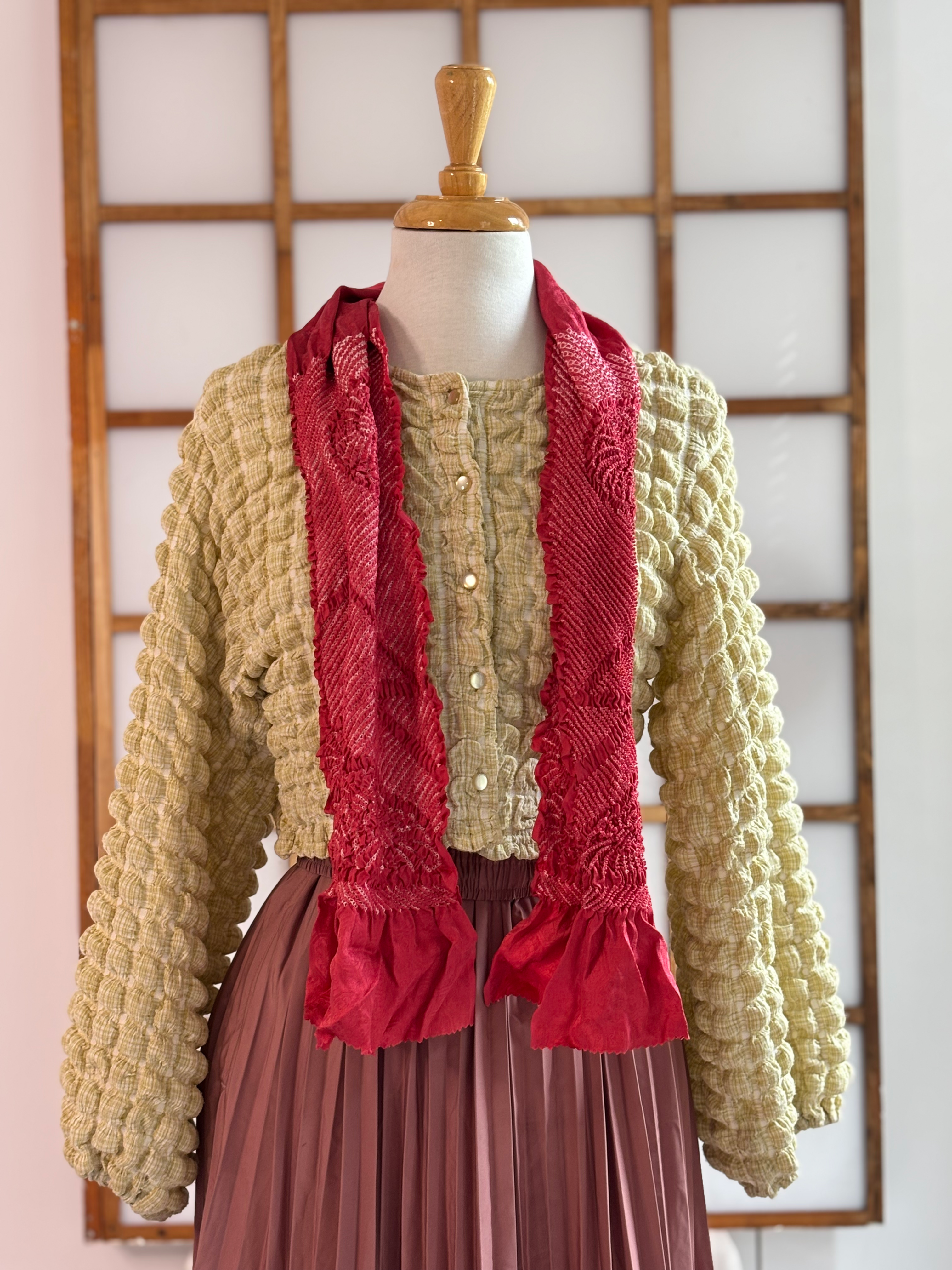

Showa Era - 1950s-1960s - Hand-dyed Silk - Five Ways to Wear
THE MEANING
The kiku - chrysanthemum - represents longevity, rejuvenation and the dignity of a life well-lived. In crimson red - one of the most auspicious colours in Japanese culture - it carries an additional layer of meaning: vitality, celebration and good fortune. A gift for a significant birthday, a wedding or any occasion that matters.
THE CRAFT
Shibori is a Japanese resist-dyeing technique where fabric is bound by hand before dyeing. The large chrysanthemum on this piece is formed by the binding itself - the petals radiating outward from the centre of the knot. The surrounding texture is created by the same process. No two shibori pieces are identical - this pattern cannot be reproduced exactly.
THE OBIAGE
Traditionally the obiage was worn beneath the obi sash of a kimono - a strip of silk that added colour and texture at the waist, tucked in so it peeked above the belt as a deliberate detail. Today it works as a belt, a scarf, a headwrap or a bag charm - the same piece of silk, worn five different ways.
FABRIC & DETAILS
- 100% vintage silk
- Hand-dyed shibori - large kiku (chrysanthemum) motif in deep crimson
- Significant stretch in the fabric - one size fits all waists comfortably
- Fringed ends - Showa era - likely 1950s-1960s
- Excellent vintage condition
HOW TO WEAR IT
- Tied as a wide belt over a haori - the crimson adds warmth and depth to most colours
- Worn as a sash over a dress or tailored trousers
- Draped as a neck scarf
- Tied as a headscarf or hair wrap
- Looped through a bag handle as a bag charm
The stretch in the fabric means it fits all waists comfortably with no adjustment needed.
GIFTING
The kiku in crimson red is a powerful combination - longevity and good fortune in one piece. A milestone birthday gift, a wedding gift or any occasion that deserves something with genuine meaning. Works particularly well with the mustard check haori, the ivory contrast stitching haori or the sage green wave haori - the crimson creates a striking contrast against all three.
ORIGIN & CONDITION
Sourced in Japan. Showa era - likely 1950s-1960s. Excellent vintage condition.
CARE
Hand wash with care or dry clean. Store flat away from direct sunlight.
SHIPPING & RETURNS
Free shipping within Australia. We also ship to the UK, Ireland, New Zealand and the United States. Returns accepted within 14 days of delivery - contact us at hello@himoandkimo.com to arrange. Return shipping costs are the responsibility of the customer.